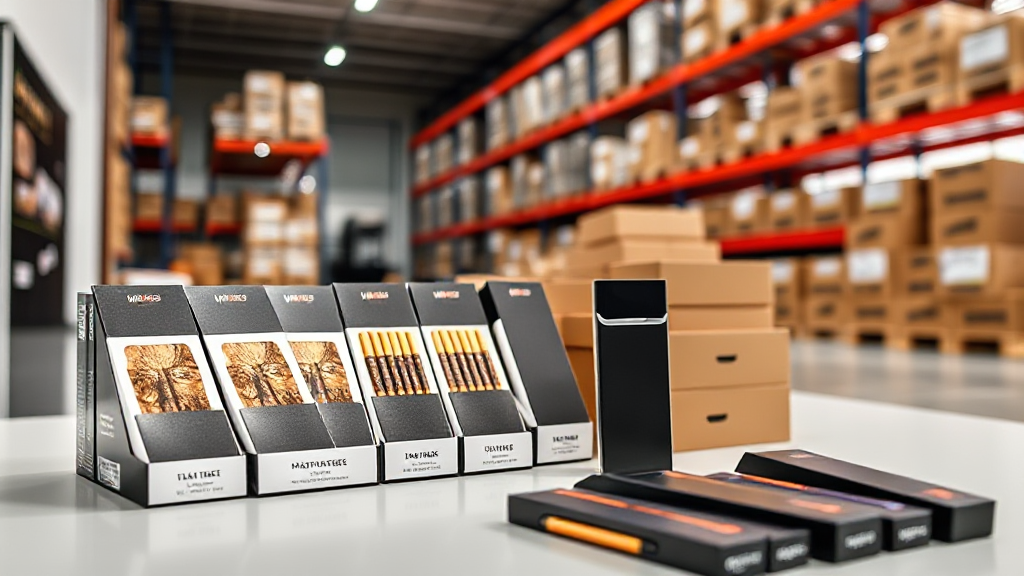
Cross-Border Delivery and Payment Terms for Heated Tobacco Cartons in the EU
Imagine you live in one EU member state and you place an order for sealed cartons of heated tobacco sticks from a shop registered in another. The parcel has to cross a border, pass through at least two logistics networks, and arrive at your door without a single pack being opened along the way. What makes that possible is not just good packaging. It is the documentation and data trail created by the shop’s delivery and payment terms. Understanding that trail is useful whether you are a first-time buyer or someone who orders carton quantities regularly.
This article walks through the four stages where that trail becomes visible: the order confirmation, the payment reconciliation, the tracking continuity, and the final delivery confirmation. It is written from the perspective of an adult EU buyer who wants to know what to expect, what to check, and what to keep.
Order Confirmation: The First Document in the Chain
When you complete a purchase from an online heated tobacco retailer, the order confirmation email is more than a receipt. It is the first formal record that ties your payment to a specific shipment. In cross-border trade, that record matters because it establishes what was ordered, in what quantity, and under which commercial terms.
A well-structured confirmation typically includes the order number, the exact product lines with brand and variant names, the quantity in packs or cartons, the unit price, the applicable VAT treatment, and the delivery address. For heated tobacco products, the variant naming is important: TEREA, LEVIA, DELIA, NEO, VEO, RIVO, and VIRTO lines are not interchangeable, and a confirmation that lists them precisely reduces the risk of a picking error at the warehouse.
It also helps to check whether the confirmation states the Incoterms or delivery responsibility. In simple consumer e-commerce, this is usually expressed in plain language: who arranges the carrier, who bears the risk until delivery, and what happens if the parcel is lost in transit. If the shop ships from a different member state than your own, that allocation of responsibility is the backbone of any later claim.
Keep this document. It is the reference point against which every later stage is checked.
Payment Reconciliation: Matching What Left Your Account to What Was Ordered
Payment reconciliation is the stage most buyers ignore until something goes wrong. In a cross-border order, the amount debited from your account should match the order total, including any shipping fee and any VAT or duty adjustment disclosed at checkout. Differences can appear for legitimate reasons, such as currency conversion if the shop prices in a currency other than your own, or a separate shipping line item charged by the carrier.
What you want to verify is that the payment reference on your bank or card statement corresponds to the order number in your confirmation. Many EU retailers include an order reference in the payment descriptor precisely so that reconciliation is straightforward. If the descriptor is generic or truncated, match the amount and date instead, and keep a note of the match.
It is also worth understanding the payment methods the shop accepts and how each one behaves across borders. Card payments settle quickly but may carry a foreign transaction fee depending on your bank. Bank transfers can take one to three business days and may require you to include a reference. Some shops offer local payment schemes that only work within a single member state, which is why a cross-border buyer should confirm which methods are available before checkout rather than after.
If the shop issues an invoice separate from the order confirmation, store both. The invoice is often the document that matters for warranty, returns, and any tax-related query.
Tracking Continuity: Following the Parcel Across Member States
Tracking continuity is where cross-border logistics becomes visible. A parcel moving between EU member states may pass through the shop’s warehouse, a national postal or courier network, a cross-border line-haul, and finally a last-mile carrier in your country. Each of those legs can generate its own tracking event, and the quality of the delivery terms determines whether those events appear in one continuous timeline or fragment into separate references.
Good practice, from the buyer’s side, is to note the tracking number as soon as it is issued and to follow it through the handover points. A gap in the timeline is not automatically a problem, but a gap that lasts more than a few business days, or a status that stops updating at a border facility, is worth a polite query to the shop’s support channel. The order confirmation and payment record you kept earlier are exactly what you will be asked for.
There is also a packaging dimension to tracking continuity. Sealed original packs shipped by the carton are easier to trace because the carton itself carries manufacturer markings that correspond to the product line. If a parcel arrives with a damaged outer box, photograph it before opening, and compare the contents against the order confirmation. This is standard practice for any high-value cross-border shipment, and heated tobacco cartons are no exception.
For buyers who order regularly, it helps to know which carrier the shop uses for your destination country and roughly how long each leg takes. That expectation-setting is part of what the delivery terms are for.
Delivery Confirmation: Closing the Loop and Keeping Records
Delivery confirmation is the final stage, and it is where the paper and data trail either closes cleanly or leaves an open question. When the parcel is handed over, the carrier records a delivery event, sometimes with a signature, sometimes with a photo, and sometimes with a simple scan at your address. That record is the shop’s proof of performance and your proof of receipt.
Check the parcel against the order confirmation on the same day it arrives. Confirm the number of cartons, the product lines, and the condition of the seals. If anything is missing or damaged, report it through the shop’s stated process as soon as possible, referencing the order number, the payment record, and the delivery event. Most cross-border disputes are resolved faster when the buyer can present a complete chain of documents rather than a partial one.
For your own records, keep four items together: the order confirmation, the payment record, the tracking history, and the delivery confirmation. That set is enough to answer almost any question that arises later, whether it concerns a return, a warranty claim, or a repeat order where you want the same terms applied.
None of this is complicated, but it is easy to overlook when an order goes smoothly. The value of understanding the delivery and payment terms behind a cross-border heated tobacco purchase is that when something does not go smoothly, you already know which document to reach for and which question to ask.